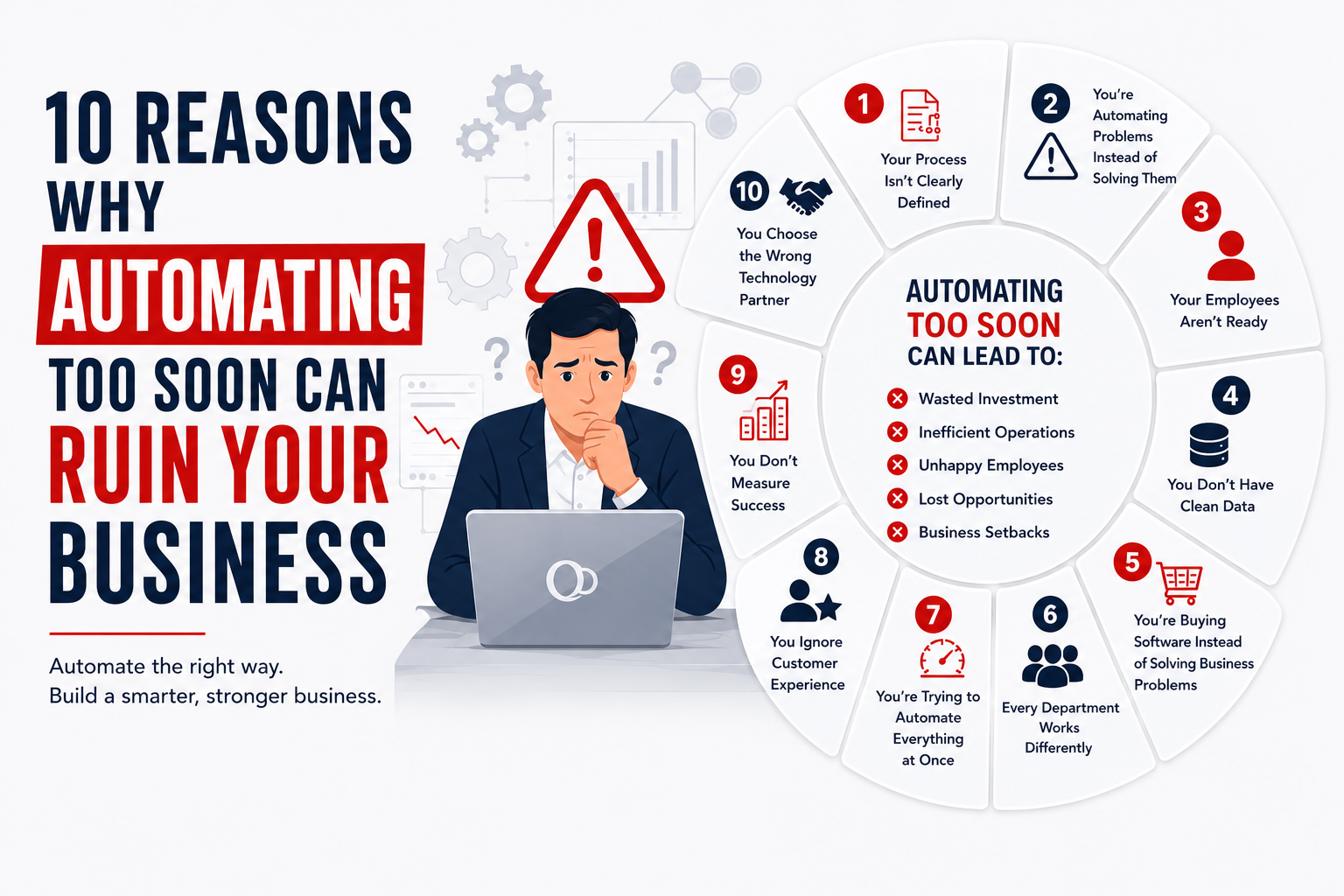
Business automation can increase efficiency, reduce costs, and improve customer experience—but only when implemented strategically. Many businesses rush into automation expecting instant results, only to face operational issues, unhappy employees, and wasted investments. Before automating your business, understand these 10 critical mistakes and learn how the right technology partner can help you automate the right way.
Business automation has become one of the biggest trends in digital transformation. From automated sales processes and inventory management to AI-powered customer support, businesses are investing heavily in technology to stay competitive.
However, automation is not a magic solution.
At Odecci Solutions Inc., we've seen businesses spend thousands—even millions—on automation projects that ultimately failed because they automated the wrong processes or skipped essential planning.
The reality is simple:
Automating a broken process only makes the problems happen faster.
Before investing in automation software or custom business applications, make sure your business is actually ready.
1. Your Business Process Isn't Clearly Defined
Automation follows rules.
If your workflow changes every day or depends on someone's memory, automation will only create confusion.
Before automation, ask yourself:
- Is every step documented?
- Does everyone follow the same workflow?
- Can new employees easily understand the process?
If not, your first investment should be improving your business process—not software.
2. You're Automating Problems Instead of Solving Them
Many companies believe automation will "fix" inefficient operations.
It won't.
If approvals are slow because managers don't respond, automating the approval won't solve the delay.
Instead, identify:
- Process bottlenecks
- Duplicate tasks
- Manual errors
- Communication issues
Automation should improve a good process—not rescue a bad one.
3. Your Employees Aren't Ready
Technology doesn't fail.
People resist change.
Without proper training and communication, employees may:
- Ignore the new system
- Return to manual processes
- Create workarounds
- Enter inaccurate data
Successful digital transformation always includes change management.
4. You Don't Have Clean Data
Automation depends on data.
If your customer records, inventory, pricing, or employee information are inaccurate, automation simply spreads incorrect information faster.
Before implementation:
- Remove duplicate records
- Standardize naming conventions
- Validate existing data
- Organize historical information
Good automation starts with good data.
5. You're Buying Software Instead of Solving Business Problems
One of the biggest mistakes businesses make is purchasing software because it's popular.
Instead, ask:
- What business problem are we solving?
- What ROI do we expect?
- Which department benefits first?
Technology should always support business oobjectives—not the other way around.
6. Every Department Works Differently
Sales uses one process.
Operations uses another.
Finance uses spreadsheets.
HR uses emails.
When departments operate independently, automation becomes difficult because systems cannot communicate effectively.
Before automating, align departments around standardized workflows.
This creates a stronger foundation for future integrations.
7. You're Trying to Automate Everything at Once
Large automation projects often fail because businesses attempt to digitize every process simultaneously.
A smarter strategy is to automate gradually.
Start with high-impact areas like:
- Customer inquiries
- Sales quotations
- Inventory tracking
- Employee attendance
- Document approvals
Quick wins build confidence and reduce implementation risks.
8. You Ignore Customer Experience
Internal efficiency is important.
Customer satisfaction is even more important.
Automation should make doing business easier—not harder.
Examples include:
- Faster response times
- Easier online booking
- Automated order tracking
- Personalized communication
- Simplified payment processes
Always design automation around customer experience.
9. You Don't Measure Success
How do you know automation is working?
Many businesses never define success metrics.
Track KPIs such as:
- Processing time
- Customer satisfaction
- Cost reduction
- Error rates
- Employee productivity
- Revenue growth
Without measurable goals, it's impossible to evaluate ROI.
10. You Choose the Wrong Technology Partner
Perhaps the biggest reason automation projects fail is choosing a vendor that only develops software instead of understanding the business.
A successful automation partner should first ask:
- How does your business operate?
- What challenges are you experiencing?
- Which processes create the most delays?
- Where can technology generate the highest return?
Only after understanding the business should development begin.
Automation Isn't About Replacing People
One common misconception is that automation replaces employees.
In reality, effective business automation removes repetitive, time-consuming tasks so your team can focus on work that creates more value.
When employees spend less time on manual encoding, paperwork, or repetitive approvals, they gain more time for customer service, innovation, and strategic decision-making.
The goal is not fewer people.
The goal is smarter operations.
Why Businesses Partner with Odecci Solutions Inc.
At Odecci Solutions Inc., we believe automation should solve business problems—not create new ones.
That's why every automation project begins with understanding your organization before writing a single line of code.
Our process focuses on:
Business Process Discovery
We analyze your current workflow, identify bottlenecks, and document how your business truly operates before recommending any technology.
Process Optimization
Rather than automating inefficient practices, we redesign workflows to improve speed, consistency, and scalability.
Custom Software Development
Instead of forcing your business to adapt to generic software, we build solutions that align with your operations, goals, and future growth.
Scalable Digital Transformation
Whether you need a web application, mobile app, workflow automation, or system integration, our solutions are designed to grow alongside your business.
Long-Term Partnership
Automation is an ongoing journey. We provide continuous support, system enhancements, and strategic guidance to help your technology evolve with your business.
At Odecci, we don't just build software—we partner with businesses to create smarter, more efficient operations through thoughtful automation.
Final Thoughts
Business automation is one of the most valuable investments a company can make—but only when approached with the right strategy.
Before purchasing software or implementing automation, take the time to evaluate your processes, prepare your team, and define your business goals.
The most successful automation projects don't start with technology.
They start with understanding the business.
If you're considering automating your operations, working with an experienced technology partner can help you avoid costly mistakes and ensure your investment delivers lasting value.